What if your product data knew why your customers buy? What if your DAM held the persona behind every image? What if AI could bridge the gap between what you sell and who needs it?
At the 2025 Akeneo Conference, I stood on stage as a Akeneo Global Ambassador and shared a vision: connecting the siloed worlds of PIM, DAM, and CRM would give AI the context it desperately needs—the ability to understand product, content, and customer as a unified story, not isolated data points.
As a designer, I've always thought in personas. As a marketer and former salesman, I know that companies succeed when they constantly think about their customer's pain points. This project is my proof that product information management is evolving into product experience management—and that evolution changes everything about how we connect with our buyers.
I've spent fifteen years watching design and marketing technology evolve. I've seen DAMs deployed as expensive storage lockers for assets that marketing teams can't find when they need them. I've seen PIMs built as pure data warehouses—perfect for populating ecommerce checkout pages, but silent about the problems those products solve or the people they're designed for.
This narrow thinking misses the point. Product data should be persuasive. It should know that a rain jacket isn't just waterproof—it's for the event planner who needs to look professional while managing outdoor logistics. It should know that a cable-knit sweater isn't just warm—it's for the corporate gifting manager who wants to signal quality and care to their new hires.
The future belongs to PXM—Product Experience Management. PIM vendors like Akeneo are already moving in this direction, but the industry hasn't fully grasped the implication: when your product information carries marketing intent and connects to your customer information carrying needs context, AI can finally generate campaigns that are genuinely relevant, not just grammatically correct.
That's what this project proves. Not just that the technology works, but that the vision is worth pursuing. When a CRM tells us WHO, and a PIM tells us WHY, and a DAM shows us HOW IT LOOKS—AI can finally synthesize WHAT TO SAY. That's the evolution from catalog to intelligence. That's the future I'm building toward.
From conference stage to working system—60 days of proving that connected data architecture can power the next generation of AI-assisted marketing.
After nearly a year away from the workforce, I needed to demonstrate that my expertise in DAM, PIM, and marketing technology was still relevant in an AI-transformed landscape. The hypothesis I wanted to prove: Generative AI is only as good as the data architecture behind it. If I could build a system that connected CRM (who), enriched PIM (why), and curated DAM (how it looks) into a single intelligent pipeline, I could generate campaigns that understood context—not just filled templates. I installed a PIM on my laptop.
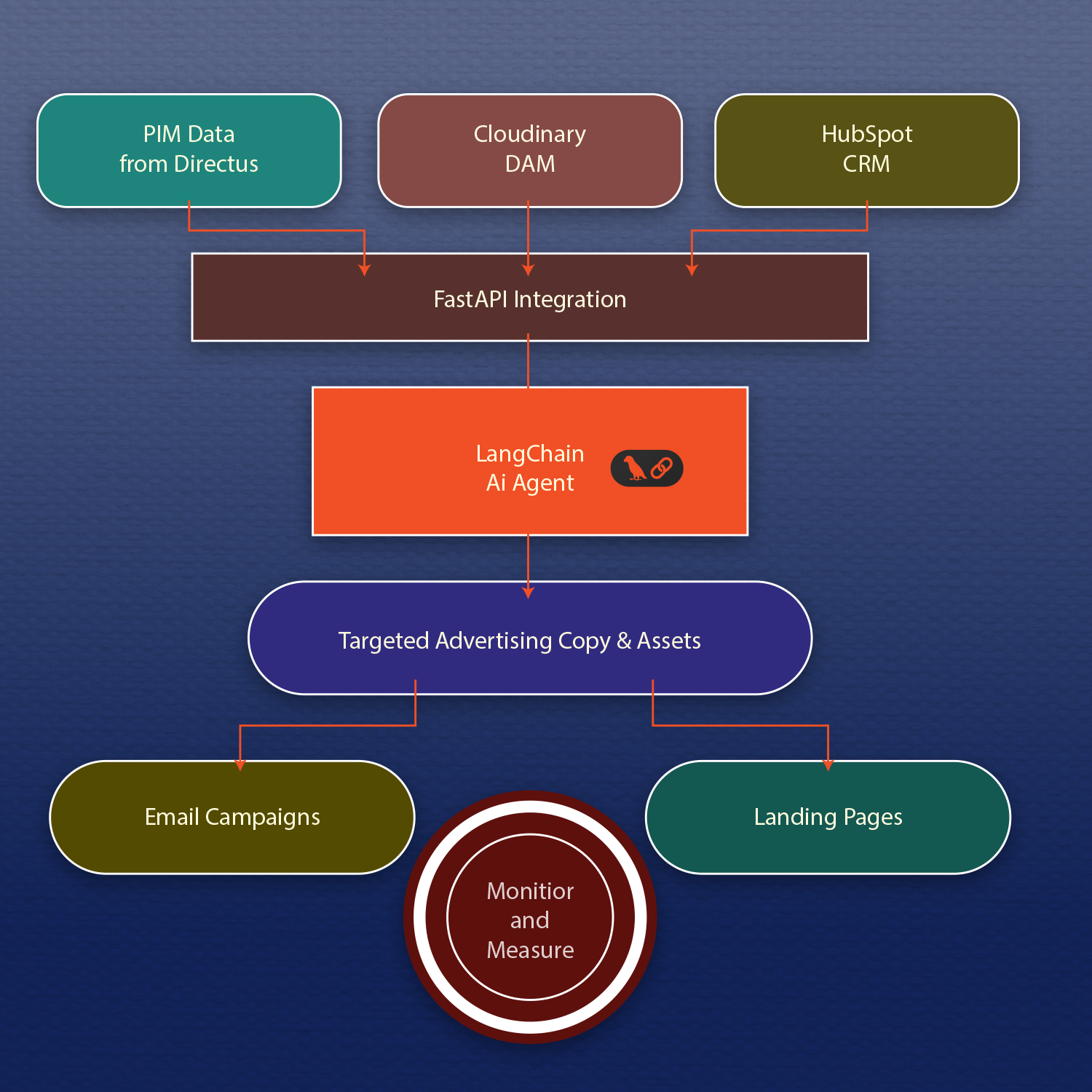
I started building the foundation: Directus as a headless PIM, Cloudinary as DAM, HubSpot for CRM signals, and FastAPI to orchestrate everything. Immediately, I hit the core problem that validates my entire thesis—most PIM data is too thin. It describes product specifications (what it is) but lacks the marketing intelligence (what it's for, who needs it, when to recommend it).
I began manually enriching the Urban Threads catalog with use-case metadata, buyer personas, and situational relevance. This wasn't just data entry—it was proving that persuasive product data looks fundamentally different from descriptive product data.
Initially, I experimented with DALL-E for product mockups. The results were visually interesting but fundamentally flawed—they couldn't represent actual SKUs accurately, and they lacked the credibility that comes from real product visualization. I pivoted to Printful's API for photorealistic product mockups with actual customer logos applied to real garments.
This taught me a crucial lesson about grounded AI: the best campaigns use AI for composition and copy generation, but anchor everything to real, controllable assets from the DAM. The story is stronger when you can point to actual products and actual brand imagery.
The breakthrough came when I stopped thinking about separate workflows for "campaign generation"
and "mockup generation" and "customer scoring." I built a single /pxm/campaign/generate
endpoint that takes a company name, scenario, and tone—then orchestrates CRM lookups, PIM product
matching, DAM asset retrieval, AI copy generation, and Printful mockup rendering into
one synchronous response.
What used to require five API calls across three separate systems now happens in one call that returns a complete campaign brief, email HTML, landing page HTML, and a branded product mockup URL. This isn't just technical elegance—it's a demonstration of how PXM architecture can collapse complexity into simplicity.
Today, the PXM Campaign Studio is deployed and running. You can select a prospect from HubSpot, choose a campaign scenario, set the tone, pick a hero image from the DAM, and watch the system generate a complete, data-grounded campaign in under 30 seconds. Every piece connects to real data in real systems. Every output is traceable to its source.
The gap in current marketing technology isn't better AI models—it's better-connected data architecture. PIM vendors like Akeneo are moving toward PXM. DAM systems want to be more than storage. CRMs are hungry for product context.
The winners in this space will be the architects who can connect these systems into a coherent intelligence layer. The experience of product—understanding why someone needs it and how it fits into their story—requires breaking down the silos we've built around our data.
As a designer, I think about the persona receiving the message. As a marketer and former salesman, I think about the pain point that needs solving. This project brings those perspectives together: product design intent meets customer need through connected data architecture.
That's the future I'm positioning for. Not just someone who understands PIM or DAM or CRM individually, but someone who sees how they become greater than the sum of their parts when connected with strategic intent.
To prove this system works, I needed a real brand with real assets—not hypothetical data, but the kind of complexity that real product marketers deal with every day. So I built Urban Threads from scratch.
Urban Threads represents a premium streetwear brand selling direct-to-consumer while also building a B2B corporate gifting and employee onboarding business. This dual audience creates the exact challenge PXM was built for: the same products need different stories for different buyers.
A fleece hoodie to a retail customer is about style and comfort. The same fleece hoodie to a corporate gifting manager is about quality perception, brand alignment, and making new hires feel welcomed. The PIM has to know both stories. The CRM has to know which buyer you're talking to. The AI has to know which narrative to use.
The culmination of this project: a live web application where connected data becomes intelligent campaigns. Select a prospect, choose a scenario, set the tone, and watch the system orchestrate a complete, context-aware campaign in real time.
Pulls live HubSpot accounts with enriched scoring based on engagement, segment, and simulated purchase behavior. Knows WHO you're talking to.
Matches products to prospect needs using enriched metadata about use cases, personas, and situational relevance. Knows WHY they need it.
Selects brand-consistent hero images from Cloudinary based on campaign context and buyer persona. Shows HOW it looks.
One API call orchestrates everything—generates brief, email HTML, landing page HTML, and branded product mockup. Delivers WHAT TO SAY.
Give it 20 seconds on first load—it's connecting to HubSpot, Directus, and Cloudinary in real time.
PIM → DAM → CRM → FastAPI → AI → Campaign. Every layer connected. Every output grounded in real data.
The PXM Campaign Studio is live and waiting. Select a prospect, pick a scenario, choose your tone, and watch the full system orchestrate a data-grounded campaign in real time.
⚡ Launch the Studio Now